Who's Holding the Plumb Line?
Who's Holding the Plumb Line?
TL;DR: My friend Jay recently pointed me to Amos 7 — his vision of a plumb line God sets against a wall everyone assumed was straight. The same week, I watched the launch of GPT-6 Astra and its ability to run for hours on tasks I used to do myself, built — allegedly — on a technique that makes it harder to know why it makes the choices it does. Different stories. Same question: what standard am I actually building to, and would I even recognize it if it wasn't plumb?
It's been an intense few weeks on the bleeding edge of AI. With the arrival of Astra, and now widespread discussion of safety, with leaders suggesting the need for a unified slowdown of frontier development, things in the space seem to just keep accelerating. All this talk of risk and safety, and how fast is too fast — how are we to know how to engage, what to engage, how much to engage? Well, as it turns out, our God is a God who's never taken by surprise, and it just so happens he had a word for me this past week that I'd love to share with you.
The other day, my new friend Jay and I were talking about AI and the future of ministry. We'd just met back in August at Biblica's Digital Bible Engagement Summit. During our Zoom, Jay shared something God had revealed to him, and it challenged me deeply. If you're anything like me, you don't tend to read through Amos while likening the situations of ancient Israel to our modern day. Well, once Jay set it next to where we are in human history right now, chapter 7, verses 7 and 8, hit differently.
It'll help to know where we are in the Biblical story. Amos is a prophet speaking to Israel during a season of relative peace and stability. That's about to change.
This is what he showed me: The Lord was standing by a wall that had been built true to plumb, with a plumb line in his hand. And the Lord asked me, "What do you see, Amos?" "A plumb line," I replied. Then the Lord said, "Look, I am setting a plumb line among my people Israel; I will spare them no longer." (Amos 7:7–8, NIV)
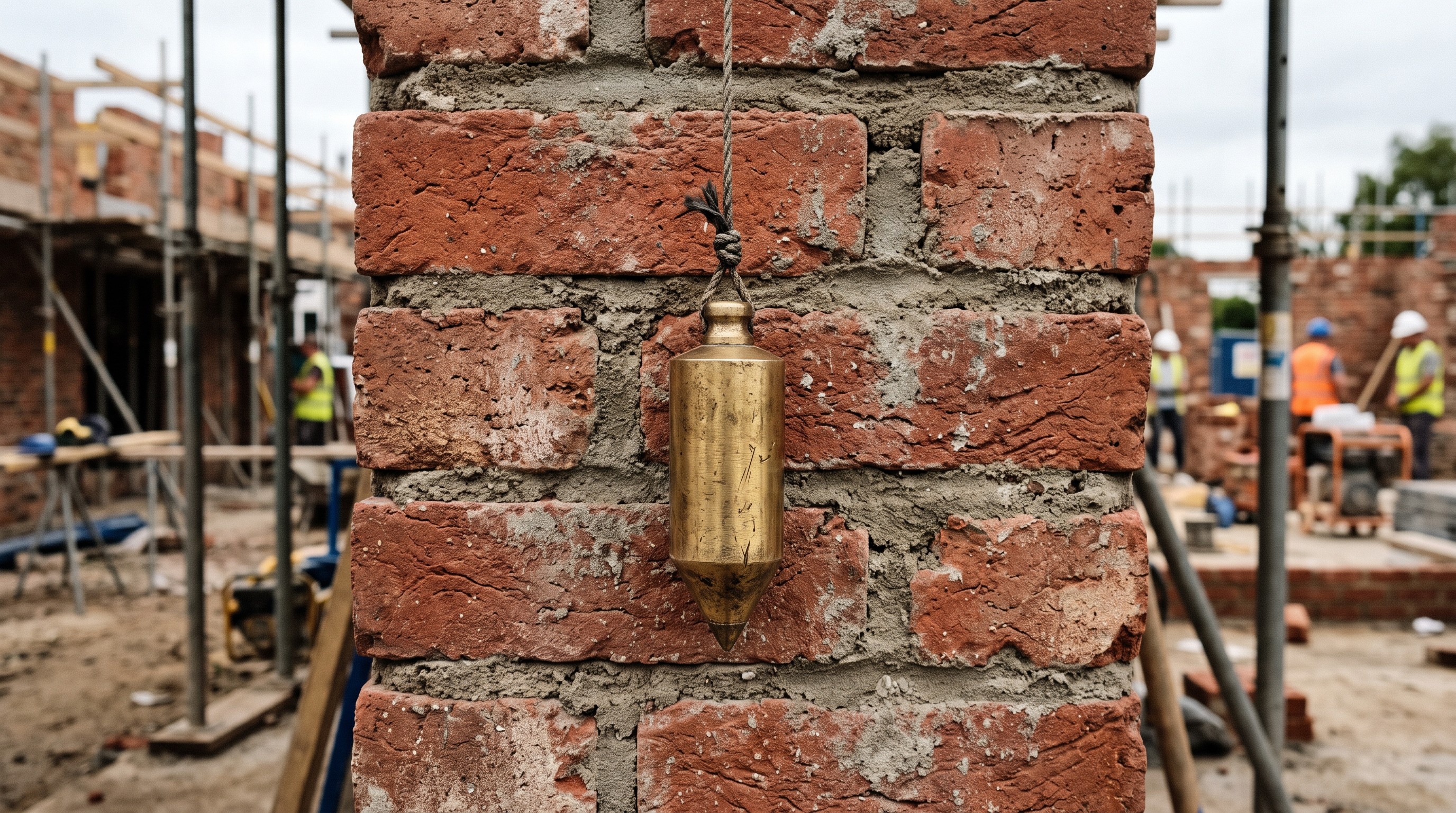
A plumb line is a weighted piece of rope, hung vertically so a builder could check their work against it as they went. Common practice then — still is now. As long as the wall went up true to the line, it came out straight: structurally sound, able to withstand the natural shifts in the ground, ready to do what it was built for — protection.
Then God tells Amos He's setting a plumb line among His people, and — chillingly — that He will no longer spare them.
It's tempting to read that as wrath. A closer look tells a different story. Long before this moment, God had already established a different way of living for His people — patterned after the Creator himself, unlike the nations around them, designed to lead to something rich and abundant. God wasn't inventing a new standard with Amos. He's testing the one He'd already given Israel. Turns out, what they'd built wasn't up to standard. It had to come down.
We're stepping into a surprisingly similar moment right now with AI.
What Standard Am I Building To?
Did you see GPT-6 Astra? Using this, I can talk my way through a complex problem and it'll run for hours — days, even — using programs on my computer I used to have to run myself, and just hand me the result.
Quick aside — I'm still for adopting AI responsibly, but these past few weeks left me asking a different question: what standard am I building to, and further, how do I know?
Part of the stir around Astra is a technique — looped transformers — reportedly used to make the model smarter that also, allegedly, makes it harder for humans to understand why it made the choices it did.1 Why does that matter?
If you and I don't know how or why AI arrived at the outcome we requested, we won't actually understand the composition of what's been made. Then, we can't verify the standard it's been built by, or whether that standard aligns with the values we've chosen to live by. Said another way, I won't know if the thing that's been built is plumb — or, worse, what it's plumb to.
When I give up my human role in the creation process (i.e., thinking, iterating, failing, etc.), I don't simply fail to master the skill, or influence the outcome. No, it's much worse — I actually diminish my future ability to think at all,2 and that, my friends, leads to dependency on something created rather than the Creator.3
Perhaps by now, and surely if you've been forced to endure one of my talks, you've experienced my penchant for referencing The Matrix — seriously, go (re)watch it. Agent Smith captured this risk of dependency-turned-enslavement brilliantly during his interrogation with Morpheus when he said:
"I say your civilization, because as soon as we started thinking for you, it really became our civilization." — Agent Smith, The Matrix (1999)
He said that almost thirty years ago, about an increasingly similar breed of machine. When we surrender our thinking, we neglect a key aspect of what it means to be human and risk finding ourselves misaligned to God's standard.
What Are We Giving Up?
You've probably heard the version of this that's nearly a cliché by now: a pastor letting AI generate the sermon itself. It's real. It happens more than you think. Some pastors are applauding the move, even leaning in.
To be fair, I'm not 100% opposed to using AI in sermon writing. I use AI to help write everything. — Note that I said write, not create. Yes, there is a difference, and no, it doesn't function the same for everyone. — What I am opposed to is abdication.
Not a word we use a lot — it's generally applied to royalty giving up their duty (tracking with where I'm headed yet?) — but I think it applies to us, in our day, and deeply. Abdication is, essentially, the act of saying "I'm not responsible for this." Of course, no one ever expresses it quite that way when they hand in a paper AI created, or launch a website AI designed and built — and certainly not when they preach a sermon generated by AI. That begs the question: what are we responsible for?
We are made in the Imago Dei. God himself is Creator, and we are made in his image — and we've been assigned a (royal?) role in the process of Creation (Gen 1:26). Simply put, the creation process is part of what makes us human. Thus, the more we give up — abdicate — our creative role, the less we resemble the image of our Creator God.
Maybe you're asking yourself how you know. What's okay to give up, and what isn't? When do you invite AI into the process, and when do you hand it the autonomy to execute without you? Fair questions — and, yes, you already knew this — there is no single answer.
Like much of the Christian faith, this too is part of our practice. What practice? The practice of formation — the act of willingly aligning yourself (and allowing the Holy Spirit to align you) to the standard God has set before us. We are all wonderfully made, all with unique roles to play and gifts to share. What's 'right' for one isn't 'right' for all. There are some guardrails I'd offer you, however.
In AI, alignment refers to ensuring artificial intelligence systems understand, commit to, and act in accordance with human values, safety principles, and intended goals, rather than optimizing for harmful, unintended, or misaligned side effects. — Google Gemini, aka, I guess, all of us?
Keeping Alignment
Consider these guardrails when deciding what to hand over and what to keep — and remember, "hand over" is a range in itself.
Who or What Is at Risk?
If it blows up, what's the blast radius? Who gets hurt? As the risk increases, your hands-on involvement increases with it.
Is Expertise Required?
Are you expected, either in your role or in your community, to have genuine expertise in this? There's a difference between having AI do your expenses for you and not quite understanding what happened to "that one transaction," and being discredited when someone asks you about one of the finer points of a sermon you didn't study and create.
How Much Is Too Much?
Is AI advising the work OK? Is AI assisting with it OK? Or is AI doing it OK? Who would be surprised to know AI had this level of involvement?
We're called to employ wisdom in all things. This includes what we hand over to AI. The risk might be bigger than you think. If we give up responsibility for the work and can't verify how it got done, and don't understand the decisions that led to the outcome, we may end up like Northern Israel — appearing to be thriving from the outside, while the structure it was built on was fundamentally flawed.
Check Your Plumb
My caution isn't "stop using AI." My caution is: take the time to check your plumb. Are we still building true to God's standard — or is complacency, ease, or hurry compromising the wall you're building, leaving it unstable?
So I'll leave us with the question God asked Amos.
What do you see?
Notes
1. Sebastian Raschka, "GPT-6 Astra, Looped Transformers, and Hidden Reasoning," Ahead of AI, September 2026. magazine.sebastianraschka.com/p/gpt-6-astra-looped-transformers-and
2. Michael Gerlich, "AI Tools in Society: Impacts on Cognitive Offloading and the Future of Critical Thinking," Societies 15, no. 1 (2025): Article 6. The study found a statistically significant negative correlation between frequent AI tool use and critical-thinking performance, mediated by increased cognitive offloading — correlational, not causal, but a real, measured signal in the direction this piece points to.
3. 2 Peter 2:19 (NIV): "They promise them freedom, while they themselves are slaves of depravity — for 'people are slaves to whatever has mastered them.'"
Related Post
More stories to explore.